Archive | Ethiopia RSS feed for this section

Ethiopia: Mugged by Charm in Axum

4 Jan

Axum is yet another former capital of Ethiopia, a rival to Gondar and Lalibela, where an emperor began to build a new Jerusalem about a thousand years ago, carving churches into mountainsides. But evolving from about 400 BC – as they’d say in this devout country – Axum can claim historical and religious supremacy. Not only did the Queen of Sheba have her palace here, but this, after all, is the site of the monastery of St Mary of Zion, the resting place of the Tabot, aka the Ark of the Covenant. How do we know? Fittingly, it’s a matter of faith: no outsider can actually get to see it.

Axum today might be a place of pilgrimage, but it is also, frankly, a bit of a dump and should be deleted from the non-Ethiopian non- Orthodox tourist’s to-do list. The atmosphere is as flat as the plain it’s sited on. Sheba’s Palace ruins, tick. The museum, tick. Yawn. The stelae field, tick. The church built by Haile Selassie; if we must. Yawn. Travellers’ websites bemoan the dreadful hotels – ‘which is the least bad option?’ – but no one actually advises avoid.

Avoid Axum.

Axum is the sort of town which inspires a wishing one’s life away, tomorrow is another day, tough it out, counting the hours until leaving, attitude. Yes, it has intermittent dim street lighting, a delapidated cinema, and several banks, but there’s something forsaken about it. Of course it’s safe to walk to the bar says the hotel receptionist, offended.

Heading back along the broken pavements I sense that I’m being followed. I’m right. The boys are under five feet tall and about 10 or 11. They are curious: what’s my name? Am I American? Oh. Which football team do I like? How old am I? When I stop in front of a tiny shop, they stop too and hover at the doorway. It isn’t hard to guess the man behind the counter is telling them to go away. ‘They’re with me.’ Where did thst come from? Hungry, unable to stomach any more indigestible local meat, I’ll have biscuits for dinner. I ask the boys whether they want some: they hesitate over the strawberry wafers and the bourbons.

Ten minutes later the three of us are sitting in the dictator-baroque hotel bar, tucking into bourbons and watching English premier league football and drinking. Fanta-like Mirinda for them. They both go off to the restroom to wash: at home, they don’t have a bathroom, they don’t have TV, they’re too poor, they say. They usually lurk outside bars and shops to watch anything. Their sing-song English separates every syllable, with very unEnglish rolling rrrs. ‘Not brrrot-hers, frrrr-ends.’ No, their mothers won’t worry about them being out. We exchange email addresses; apparently every child at school has one. The game transfixes them. The shop sells footballs. For 50 birr. What time am I leaving tomorrow morning? Inspired like so many of their countrymen by the late Prime Minister Meles Zenawi, whose sudden death stupified the nation, one wants to be a teacher and the other an engineer. Shocked that I am unmarried, they say will pray for me. ‘When you’re marrrrr-I-ed, you can come back to Et-eee-ooo-pah and adopt us.’

The following morning, they are waiting out by the road, with the same desperate, patient hope seen in labradors hanging around dining tables. 100 birr is probably what I would have spent on the rip-off birr-a-minute hotel Internet access – in every other hotel outside Axum it’s been free. On our way back to the biscuit shop to get the footballs, they ask if I can pay their rent instead.
Ethiopia – The Road From Beijing Avoids the Bleeding Hearts

23 Dec
Simien Mountains, Ethiopia

Simien Mountains

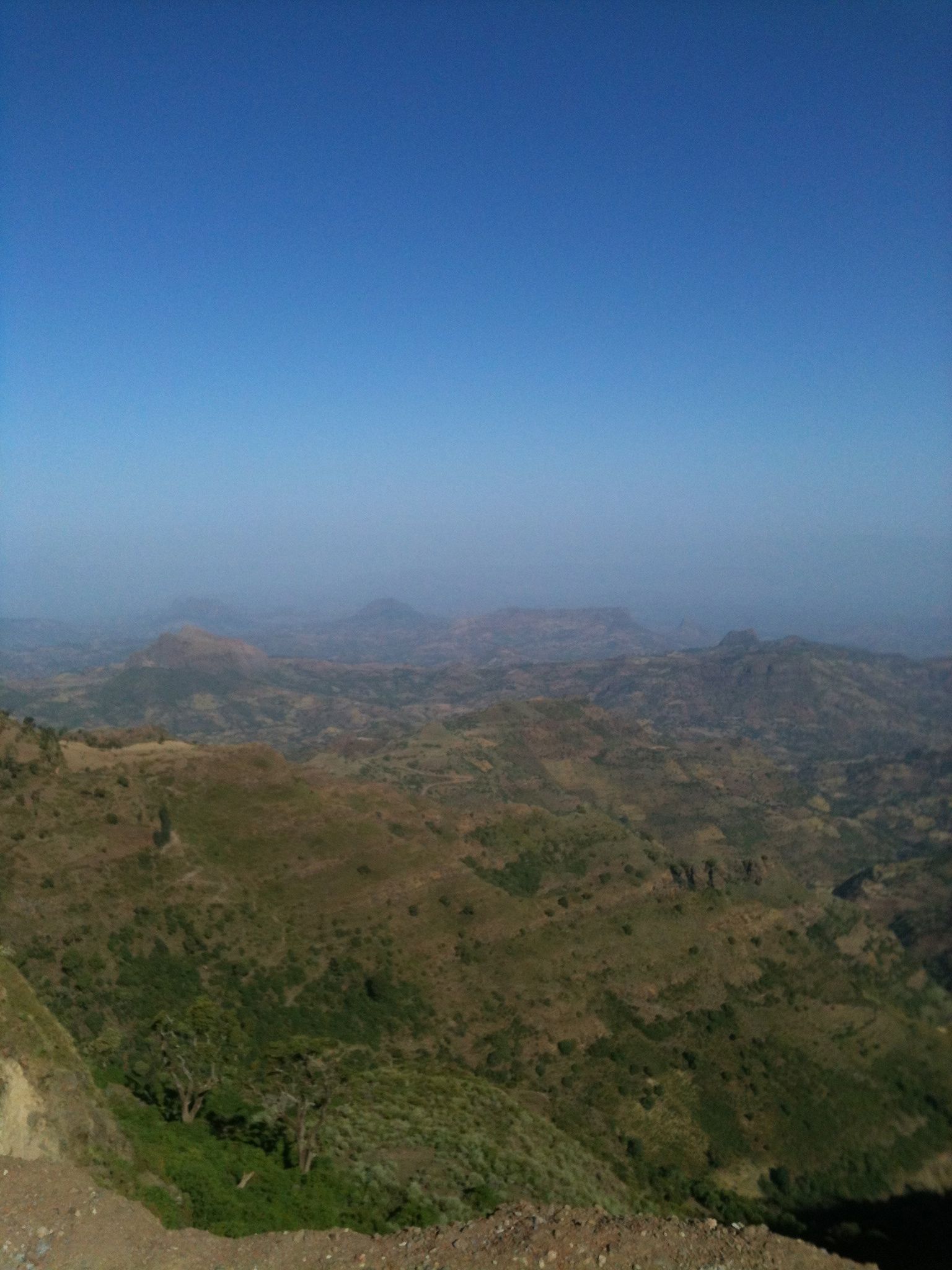
Ethiopia’s Simien Mountains and National Park beat the lot. The Grand Canyon suddenly isn’t quite so grand or Monument Valley so monumental. Mounts Kenya and Kilimanjaro are more famous, not least because they’re on the tourist/backpacker Africa trail while, right now, Ethiopia is not. Just as the country is the only part of Africa to be ignored or to remain unvanquished in the 19th century colonial ‘scramble’ by European powers, when it comes to an African destination of choice, Ethiopia has yet to get on the radar of most first-worlders, who are either desperate to live the toff White Mischief dream peddled by upmarket tour operators – tents, wicker, Landrovers, leopards and linen suits – or just desperately seeking cheap thrills, sex and booze along the Kenyan and Gambian coasts.

Instead of colonising Ethiopia, the West has recently busied itself being patronising, unable to forget civil war, famine and Geldof’s haranguing to ‘give them the fucking money’ during the Live Aid smug fest. And we haven’t stopped giving, while never starting to ask if aid not trade is such a good thing. The Ethiopians are a proud, stately and dignified people: while self-important western do-gooders on a permanant gap yah and British politicians sign up to ‘Africa – Scar on the Conscience of Humanity‘ worldview, they overlook that the country’s annual growth 2005-10 was 6.5 per cent, while infant mortality plummeted. While some in the West tut tut over sluggish mobile phone take up in Africa’s second most populous country (85 million and the numbers predicted to rocket before they crash), Ethio Telecom doesn’t seem to be doing too badly: reception was stronger in the rural mountain town of Lalibela than in 0208-land along the A3, with the priest in the remote 12th century cave church of St Nakutolab breaking off from his talk on processional crosses to answer a call.

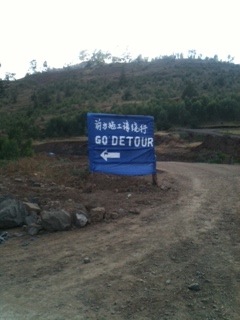
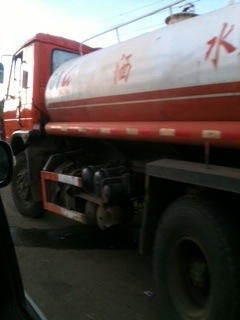
The dead-end of so much recent Western policy in Ethiopia is best symbolised by the highway between the ancient capital Gondar and the Simien National Park, more than 100 clicks of paved, pothole-free perfection. Still under construction in parts, the road building is being supervised by Chinese engineers, recognisable, somewhat ironically, by their bamboo coolie hats. Along with their fleet of Sinotruks, they’re stationed in a huge compound of pale blue Portakabins outside the town of Debark.

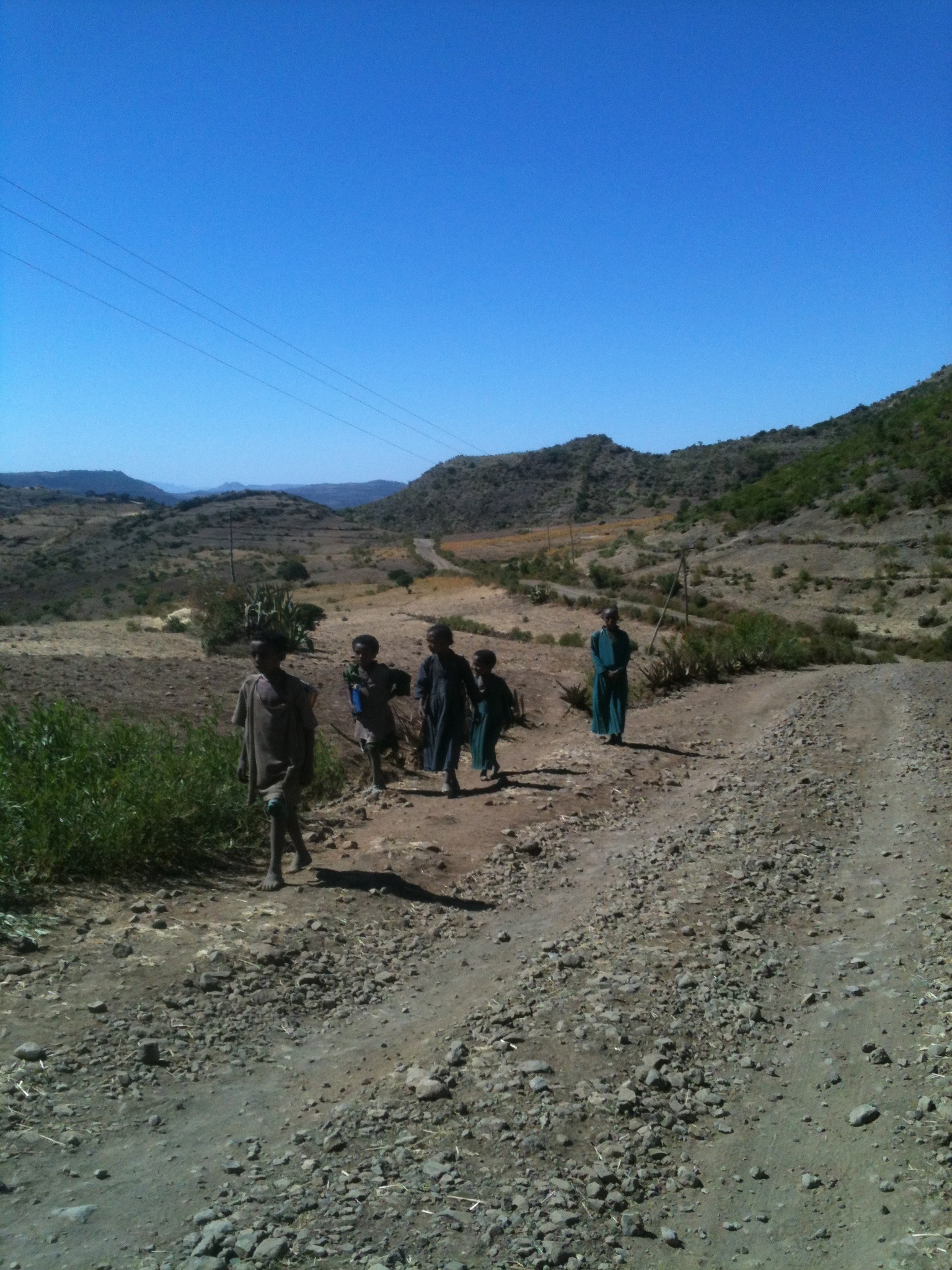
Children in countryside outside Lalibela

Children walking alongside typical road outside Lalibela

Although a cruising speed of 60mph is achievable between the villages of eucalyptus-wood clad mud shacks, the road’s main users are pedestrians, mostly aged under ten, sometimes in gangs but often on their own, many shepherding humpbacked cattle, sheep, goats and donkeys. Not so much Home Alone, as Miles Away From Anywhere Alone, these sturdy, exuberant youngsters are the most disconcerting sight for affluent Westerners, brainwashed into living in a permanent state of near hysteria about child safety.

Road-building outside Gondar, Ethiopia

Road-building outside Gondar

Sinotruk, Ethiopia

Sinotruk, Ethiopia

Of all the tangible dangers to the children living and working and playing alongside the highway, traffic doesn’t seem to be one of them.  There isn’t much, if any. In an hour there’s one minibus (level 3, the cheapest), a handful of 4x4s and the construction teams of diggers and Sinotruks, whose drivers are far too busy to enjoy some of the most spectacular views of anywhere. Outside Addis Ababa,  few own cars. But give it a decade or two, those children – for whom a mobile phone and the Internet are starting to become as much of a fact of life as TV is already – could be driving their own cars, their new-found prosperity delivered by the highway.

Gondar to Simien mountains highway, Ethiopia

Thank you Beijing: A completed section of the Gondar-Simien mountains highway, Ethiopia