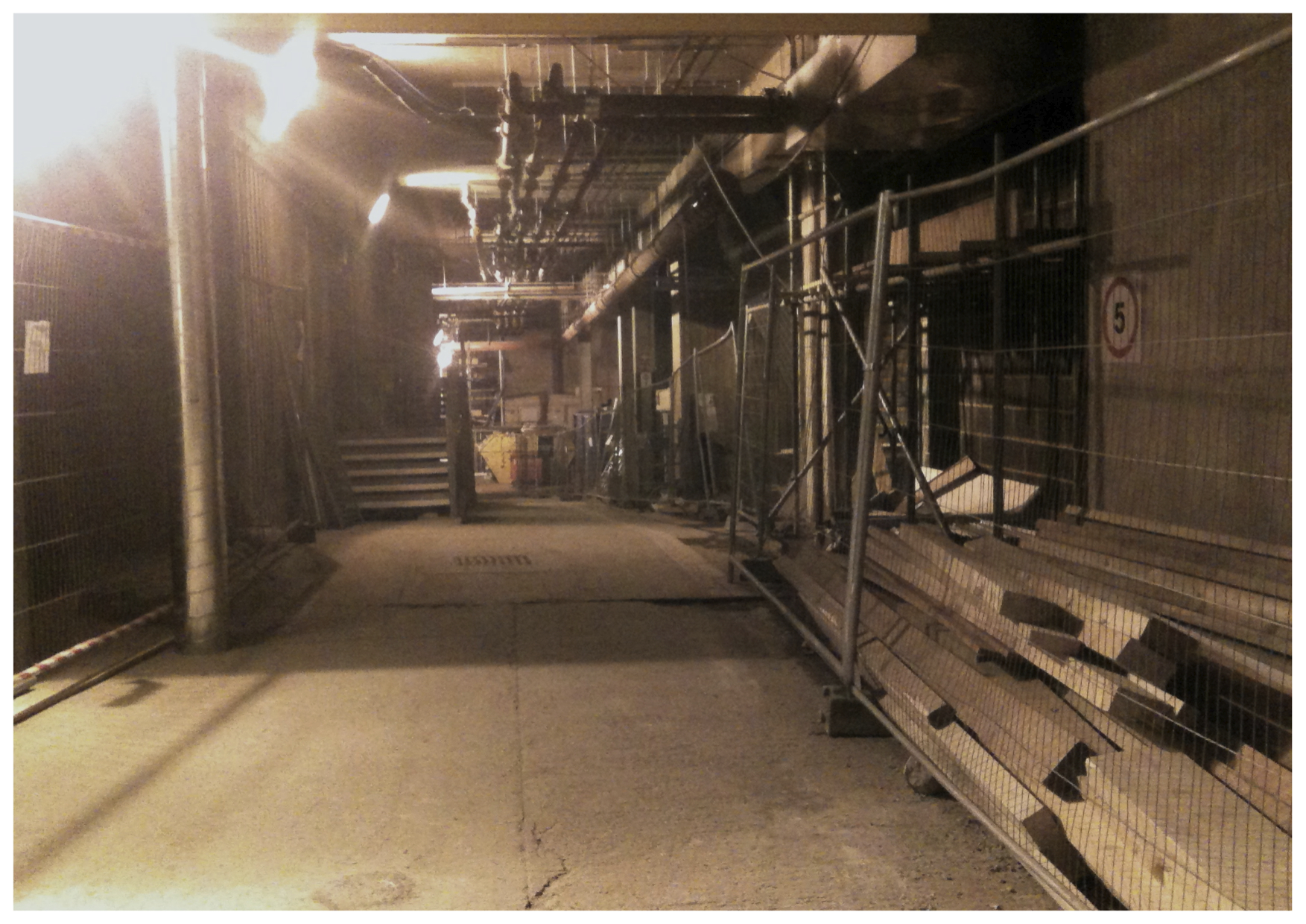
The way to Ambika P3
Drivers heading west along the Marylebone Road towards the Westway should be grateful as they pass the University of Westminster on their left. They probably don’t realise it, but deep under the building is Ambika P3, a massive space where concrete and concrete structures are tested. Structures like the columns holding up the flyover a few minutes down the road.
The subterranean laboratory is currently the venue for Stifter’s Dinge by Heiner Goebbels, who has revisited the multimedia show/performance/installation he created in 2008. Apparently it is ‘a composition for five pianos with no pianists; a performance without performers; a play with nobody acting’. Ummm. The Unguided Tour is certainly dramatic because of the cathedral-scale monumentality of the venue. On offer are five upended pianos, three shallow reservoirs of water, lights and music interspersed with chit-chat or readings from the likes of Claude Levi-Strauss. Goebbels (no relation?) is inspired by the Austrian Adalbert Stifter, a mid-19th century Romantic writer and poet. Stifter’s Thing (Ding) is an extract about travelling by horse-drawn sledge through a frozen silent forest as ice-heavy branches crash to the ground: how the other Things (Dinge) – such as Malcolm X – relate to Stifter is harder to grasp. As the programme says, this is ‘an opportunity to come to terms with unfamiliar cultural references’. In the ambient half-light as pretend-rain falls into the reservoirs, there’s plenty of time for the mind to wander, not least to unfamiliar cultural juxtapositions. Nietzsche and The Beano. Being and Nothingness: An Essay on Phenomenological Ontology and Grazia.
Stifter’s Dinge was commissioned by Artangel, now in its twentieth year of supporting the ground-breaking and conceptual. The locations – often in the capital’s disregarded crannies – are integral to the work. Last month, Kilburn’s Tin Tabernacle staged Nowhere Less Now, Lindsay Seers’ filmic exploration of a sea-faring ancestor who sailed to Zanzibar. Home to the Willesden and St Marylebone Sea Scouts, complete with wardroom, rigging, flags and portholes, the main hall of the Tabernacle was filled by an upturned wooden hull, which threatened to encase the audience. Watching Seers’ dreamy quasi-documentary, they too were cast far away on a sailing boat to the Indian Ocean island where an identical corrugated iron tabernacle can be found.
 UrbanHunterLondon
Leave a comment